
The Consumer Reports Myth
About a year after Jerry Levin took control of Sharper Image (SI) he told Businessweek, “The only way we would go bankrupt is if we run out of money.” Yogi Berra, eat your heart out.
Sharper Image’s bankruptcy four months later was surprising but not shocking. The retail sector had struggled for years with a shift to e-commerce, now there was growing financial anxiety across the economy. Less than 18 months earlier Mr. Levin’s team had taken over the company to “turn it around”. To observers at the time it seemed that Levin & company had failed – either to make the necessary changes fast enough in a challenging environment, or to identify the right changes at all.
Competitors and critics of Sharper Image’s Ionic Breeze air purifiers latched onto a simpler explanation: Sharper Image went bankrupt because Consumer Reports gave the Ionic Breeze (IB) a bad review. This legend lives on, unexamined, a dozen years later. Was it true?
In February 2002 a Consumer Reports (CR) magazine article on air cleaner products doubted the usefulness of air purifiers in general and of the Ionic Breeze in particular. SI filed sued CR for libel – largely to appease shareholders – and in an early ruling the court found that some of CR’s graphics were inaccurate and misleading. (SI should have quit the case there. We rightfully cherish our press freedoms in USA, and libel is notoriously difficult to prove in court.)
Here again is my chart of monthly net IB sales, with the Consumer Reports article date noted:
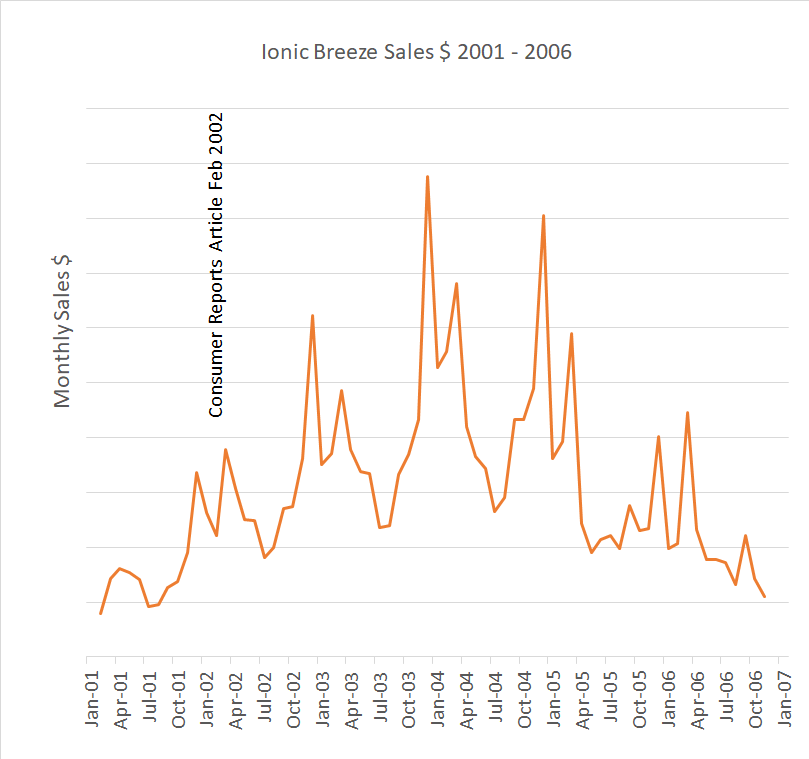
Ionic Breeze sales continued to grow for YEARS after the Consumer Reports article. In their lawsuit, SI could not demonstrate any harm from the CR coverage.
Later the sales do decline for reasons explored in previous and future posts. Consumer Reports found themselves rewarded with lots of free press for their criticisms of SI’s popular product, so they published follow-ups regularly, including pre-packaged video kits to local TV stations so local reporters could effortlessly appear to be “investigating”. This ongoing negative publicity likely did contribute to the long-term fall-off in IB sales, but CR alone was not the killer.
The rest of the story:
A consumer class-action lawsuit emerged that asserted CR’s articles as evidence against the IB. The legal claims fell flat: no consumer had ever been refused a refund or exchange, and there had never been any injuries or other proof of harm. The lawyers persisted with their weak case until parties eventually agreed on a settlement which basically bought off the class-action lawyers; consumers would receive a $19 store coupon, the attorneys would be paid some millions in cash.
Before a judge could approve this agreement Jerry Levin fulfilled his own prophecy when the company ran out of money.
 Postscripts