When is 1600 Watts only 1430 Watts?

This month Consumer Reports reviewed a handful of popular high-end hair dryer models and included each dryer’s claimed power and the power they measured:

ProductAdvertised WattsMeasured Watts
Dyson Supersonic16001430
Drybar Buttercup18751420
ghd Helios18751440
RUSK W8less20001470

All of these models use nearly the exact same power though their advertised power ranges from 1600 to 2000 Watts. What is going on? All of these companies are using a bit of Marketing Magic. One of them seems to be just wishful thinking.

What’s Watts?

The electrical power that a hair dryer uses is measured in Watts. Some of that power is used to blow air, some is lost as noise or light, and most of it is converted into the heat that will dry your hair. It’s fair to say that a dryer with higher Watts will emit more heat and dry hair faster.

Amps X Volts = Watts

Most household electrical outlets in the USA are rated for a maximum of 15 Amps. If a product actually draw 15 Amps it is likely to trip the breaker or blow the fuse – especially if anything else is on, like the bathroom light. And people usually dry their hair with the lights on. (This can even cause a fire – plenty of older homes have imperfect wiring, especially in bathrooms that were added on.) Obviously this would be inconvenient and possibly very dangerous.

As a result, for years the safety standards have only allowed appliances to draw a maximum of 12 Amps.

Electricity is nominally delivered at 120 Volts. What you actually will get at home depends on all kinds of variables, but the specified range is from about 113 to 127 Volts. Your bathroom outlet is often bit under 120, but let’s use that 120 Volts:

12 Amps X 120 Volts = 1440 Watts

Does that seem familiar? CR measured all of these dryers at 1440 Watts plus or minus 2%.

Watts up?

US electrical safety rules allow for products to vary from their Rated Watts by plus or minus 10 percent. In practice, manufacturers can hold the Watts much more closely than this. So manufacturers target production at 90% of the Rated Watts. This is the first bit of Marketing Magic, and has been common practice for decades:

90% of 1600 Watts = 1440 Watts

So a “1600 Watt” hair dryer is really a 1440 Watt hair dryer.

How did Consumer Reports measure the Supersonic at 1430 Watts?

If the Supersonic really is at 1430 Watts, it is technically out of spec to be called 1600 Watts. But it’s likely that Consumer Reports was getting a little under 120 Volts during their testing, or their measuring equipment is a tiny bit out of spec.

So how do some dryers get to 1875 Watts?

By the mid-1990s most companies in the business had 1600 Watt dryers. Competitive pressure presumably led to someone asking “How can we get a higher Watts rating?” Someone replied “Increase the Amps and Volts used in the rating!” They pushed it from both sides:

15 Amps X 125 Volts = 1875 Watts

Seems brilliant, right? 125 is within the 113 to 127 Volt range for household electricity, so in theory a someone might get 125 Volts at their bathroom outlet. (I’m unclear on how they leap from 12 to 15 Amps.) In the end it’s a rating achieved by a change in the test conditions, and not by any meaningful changes to the product. A consumer won’t actually see 1875 Watts, any more than they ever saw 1600 Watts.

Marketing Magic! In practice, the consumer is much more likely to get 120 Volts or less in their home, and observe 1440 Watts or less from their hair dryer.

(To be rated at 1875 Watts, a dryer has to pass all of the standard safety tests at 125 Volts instead of at 120 Volts, which will make everything hotter & the tests more challenging to pass. This may require some upgrades in materials and components & some increase in cost.)

Why stop at 1875 Watts?

Rating a dryer at 125 Volts lets it be advertised at 1875 Watts and gives it a marketing advantage. Why stop there?

2000 Watts!

RUSK marks their W8less dryer as 125 Volts and 2000 Watts. That implies that they are getting 16 Amps! We never saw 15 Amps, how are they getting even more?

Back to our table, RUSK measures 1470 Watts: RUSK isn’t getting any more power. They just say it does.

RUSK is a “salon” brand, not a “consumer” brand. Salon products have traditionally been sold through stylist-only specialty stores. These stores don’t always require that electric appliances be certified for compliance with safety requirements, indicated by a mark from UL, ETL, or some other third-party certifying body. RUSK is going footloose and certification-free because the stores selling the product don’t care. RUSK has gone right past Marketing Magic and is simply Making It Up. It’s all hot air.
The Consumer Reports Myth

About a year after Jerry Levin took control of Sharper Image (SI) he told Businessweek, “The only way we would go bankrupt is if we run out of money.”  Yogi Berra, eat your heart out.

Sharper Image’s bankruptcy four months later was surprising but not shocking.   The retail sector had struggled for years with a shift to e-commerce, now there was growing financial anxiety across the economy.  Less than 18 months earlier Mr. Levin’s team had taken over the company to “turn it around”.  To observers at the time it seemed that Levin & company had failed – either to make the necessary changes fast enough in a challenging environment, or to identify the right changes at all.

Competitors and critics of Sharper Image’s Ionic Breeze air purifiers latched onto a simpler explanation: Sharper Image went bankrupt because Consumer Reports gave the Ionic Breeze (IB) a bad review. This legend lives on, unexamined, a dozen years later. Was it true?

In February 2002 a Consumer Reports (CR) magazine article on air cleaner products doubted the usefulness of air purifiers in general and of the Ionic Breeze in particular.  SI filed sued CR for libel – largely to appease shareholders – and in an early ruling the court found that some of CR’s graphics were inaccurate and misleading. (SI should have quit the case there. We rightfully cherish our press freedoms in USA, and libel is notoriously difficult to prove in court.)

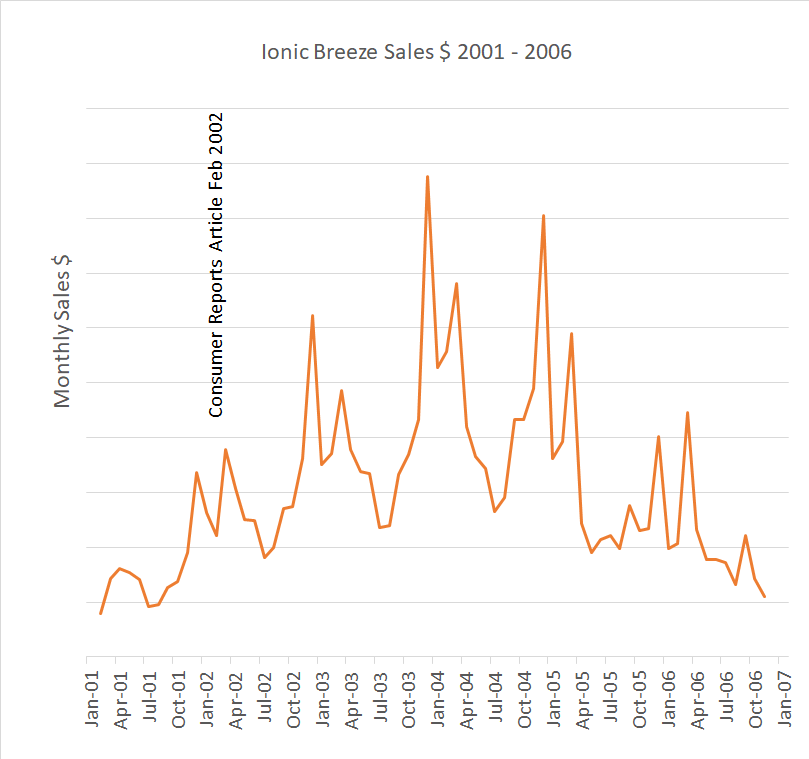
Here again is my chart of monthly net IB sales, with the Consumer Reports article date noted:

Ionic Breeze sales continued to grow for YEARS after the Consumer Reports article. In their lawsuit, SI could not demonstrate any harm from the CR coverage.

Later the sales do decline for reasons explored in previous and future posts. Consumer Reports found themselves rewarded with lots of free press for their criticisms of SI’s popular product, so they published follow-ups regularly, including pre-packaged video kits to local TV stations so local reporters could effortlessly appear to be “investigating”. This ongoing negative publicity likely did contribute to the long-term fall-off in IB sales, but CR alone was not the killer.

The rest of the story:

A consumer class-action lawsuit emerged that asserted CR’s articles as evidence against the IB.  The legal claims fell flat: no consumer had ever been refused a refund or exchange, and there had never been any injuries or other proof of harm.  The lawyers persisted with their weak case until parties eventually agreed on a settlement which basically bought off the class-action lawyers; consumers would receive a $19 store coupon, the attorneys would be paid some millions in cash.

Before a judge could approve this agreement Jerry Levin fulfilled his own prophecy when the company ran out of money.

Sharper Image’s proprietary products team developed over a hundred new products.  The biggest sellers among these were the Ionic Breeze (IB) air purifiers that, at peak, brought in hundreds of millions of dollars yearly.  This high-margin success drove spending on advertising – and everything else – closely linking the fortunes of the company to IB sales.

In the company’s late days I charted monthly Ionic Breeze “gross net sales”:

Rise and Fall

The seasonal trends stand out: a holiday surge every Q4, a plunge in January with post-holiday returns, a seasonal allergy bump in spring sliding into Q2’s “Dads and Grads” shoulder, and a lull every summer. 

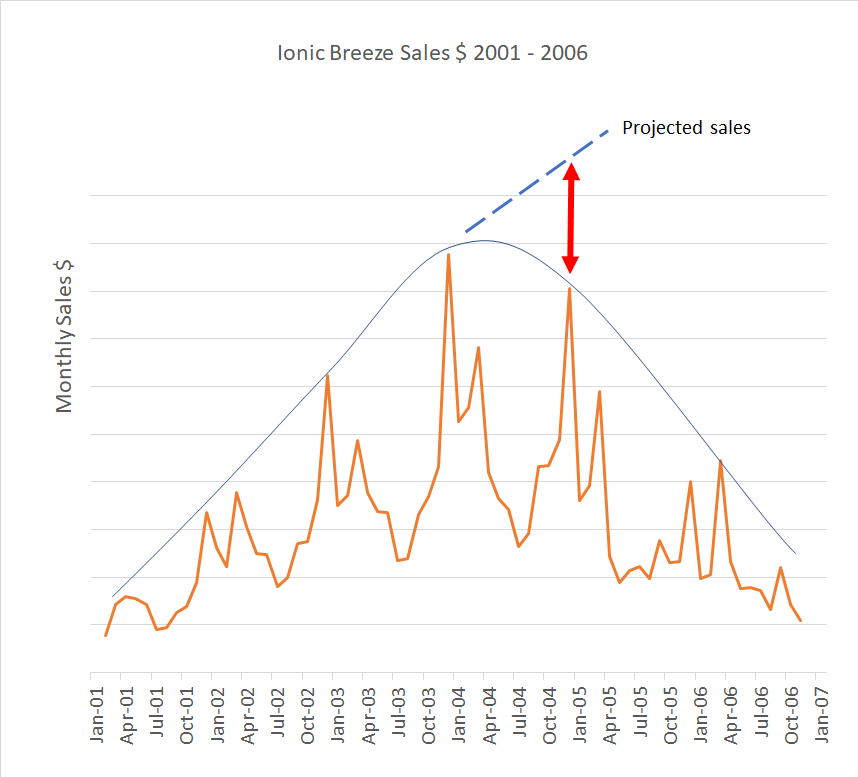
This also reveals an untold story: for Sharper Image, 2004 was the Year iPod Ate Christmas.

Apple’s iPod and its silhouette ads weren’t new but both really took hold in 2004.  That fall it became clear at Sharper Image that, of consumers who might spend several hundred dollars on a gift that holiday season, MANY chose an iPod over an IB.

The sales shortfall created kinks in the IB supply chain. After steady IB sales growth through 2004, SI had increased production & inventory to meet projected demand.  When 2004 holiday IB sales slumped instead, Sharper Image warehouses filled up with IBs.

Meanwhile my team had developed new & improved models to launch in 2005.  But new production had to wait until sales of the old models freed up cash & warehouse space.  Sharper Image enthusiastically ran discount promotions on the IBs – “BOGO” 50% off was especially popular – but the company refused to lower the price, despite emerging competition (more on this later).

The company suffered not only the drop in sales revenue, the cascading effects of inaccurate forecasting continued for the next year or more.  Clearly this was central to the company’s decline; was it fatal?

Next: the Consumer Reports Myth

The Sharper Image grew rapidly in the early aughts before business turned abruptly & the company slid downhill to bankruptcy in 2008.  I’d been an SVP there and in the aftermath lots of people asked me what went wrong – I landed a few job interviews solely to discuss that question.  I’ve run across conclusions quickly drawn by folks who clearly have very little idea of what happened.  In this and future posts I’ll explore some of the likely ’causes of death’.

(Note: the company’s brand and other assets were sold in the 2008 bankruptcy settlement, and after changing hands the brand is now owned by UPDATE: threesixty Group.  These posts discuss what happened to the original multi-channel retail company; “The Sharper Image” as a brand lives on elsewhere.)

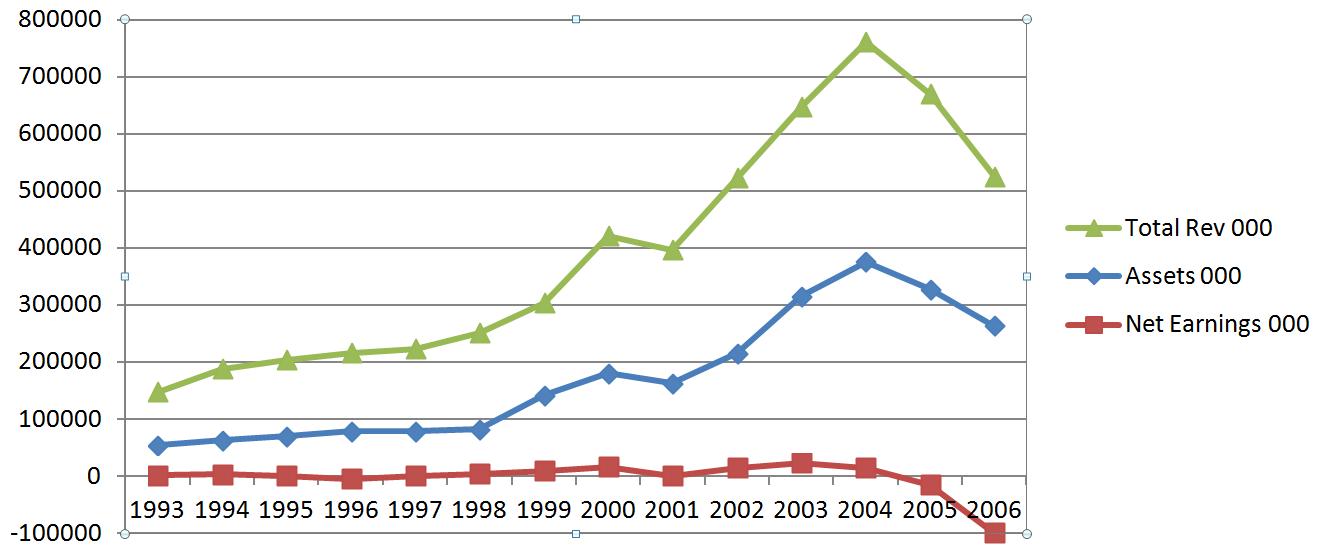
Let’s start with a snapshot of the basics: revenue, assets, and earnings pulled from the company’s annual reports.  The last year available,  fiscal 2006, ended on Jan 31, 2007.  I didn’t find any filings or data for subsequent periods, but the company filed bankruptcy just 13 months later and the trends are very clear:

tsichart01

The company grew modestly through the 90s, enjoyed a modest spike with the dot-com boom, several strong growth years, then a hard slide down.

Earnings suggest that money was managed tightly in the company, with expenses increasing to support growth.  Sharper Image didn’t own its office or stores, so its assets are largely its inventory; the company sold off product as business fell, perhaps not quickly enough.  (Did the company have the wrong products in inventory?)  The earnings collapse after 2004 suggests that margins suffered with the sell-off of inventory and, more importantly, expenses were not cut proportionately.   (More on this later.)  Earnings were down for 2004 even as sales climbed!  At the peak of the company’s success, money went out as quickly as it came in.

This brings us to Theory Number One, Over-expansion: the company invested heavily in aggressive growth and these commitments became unbearable as sales dropped.  This doesn’t explain everything, but it’s an essential part of the story.

SI637

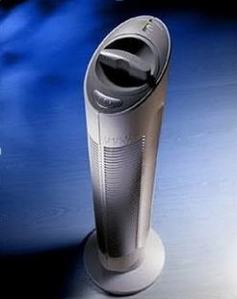
Ionic Breeze Quadra

On March 1, 1999, I began work with the Sharper Image Corporation as Manager of Product Development with the Sharper Image Design team, making the company’s proprietary products.  I arrived to find a long backlist of projects; the highest priority was a second-generation fanless air cleaner to succeed the original Ionic Breeze.

The first Ionic Breeze had been a surprise success.  During its development, the merchandising boss insisted that the company would struggle to sell even a few thousand units, so the Design team had negotiated a tiny initial production quantity.  The product quickly proved to be immensely popular… and imperfect.  Many minor incremental changes were implemented to improve performance and reliability as production ramped up.

Just as I arrived tests confirmed that simple but fundamental changes would yield a vastly superior product: the new model was configured with three deep collector blades rather than four shallow ones, and two emitter wires instead of three.  A single button stepping through three power settings replaced two knobs and the “boost” button.  A red “idiot light” indicated when things had gone wrong.

My work included coordinating the new industrial design and testing, and overseeing the detailed engineering, tooling, and production start.  Our team came up with the name “Quadra” to reflect the anticipated four-fold improvement in effectiveness, which was almost achieved.  Through careful component selection and deliberate design we significantly reduced cost – on a product launched at a price $100 higher than its predecessor.  A star was born: the high-margin Ionic Breeze Quadra went on to sell over a million units, aided by a tremendous infomercial campaign, magazine and newspaper ads, the monthly Sharper Image Catalog, and “solo mailers” featuring just this product.

How did the Ionic Breeze Quadra become so popular?  It did only a modest job cleaning the air – Quadra’s CADR was probably around 25, below the statistically-verified range of the AHAM/ASHRAE tests.  But many people who owned air cleaners hated the fan noise (users tended to turn them to the “low” settings, reducing their effectiveness, or off altogether) and were frustrated by filter replacement (which was very profitable for manufacturers and retailers).  Letters poured in praising the product…  Perhaps much of the benefit was psychological: the gratification of doing something to improve a perceived problem, and/or a placebo effect.

The Ionic Breeze was widely imitated, sent reverberations through the IAQ community, and was central in Sharper Image’s rise and, reputedly, its fall.  More on those subjects later.