
The Sharper Image grew rapidly in the early aughts before business turned abruptly & the company slid downhill to bankruptcy in 2008. I’d been an SVP there and in the aftermath lots of people asked me what went wrong – I landed a few job interviews solely to discuss that question. I’ve run across conclusions quickly drawn by folks who clearly have very little idea of what happened. In this and future posts I’ll explore some of the likely ’causes of death’.
(Note: the company’s brand and other assets were sold in the 2008 bankruptcy settlement, and after changing hands the brand is now owned by UPDATE: threesixty Group. These posts discuss what happened to the original multi-channel retail company; “The Sharper Image” as a brand lives on elsewhere.)
Let’s start with a snapshot of the basics: revenue, assets, and earnings pulled from the company’s annual reports. The last year available, fiscal 2006, ended on Jan 31, 2007. I didn’t find any filings or data for subsequent periods, but the company filed bankruptcy just 13 months later and the trends are very clear:
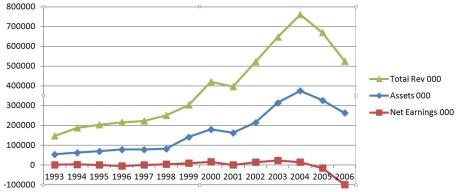
The company grew modestly through the 90s, enjoyed a modest spike with the dot-com boom, several strong growth years, then a hard slide down.
Earnings suggest that money was managed tightly in the company, with expenses increasing to support growth. Sharper Image didn’t own its office or stores, so its assets are largely its inventory; the company sold off product as business fell, perhaps not quickly enough. (Did the company have the wrong products in inventory?) The earnings collapse after 2004 suggests that margins suffered with the sell-off of inventory and, more importantly, expenses were not cut proportionately. (More on this later.) Earnings were down for 2004 even as sales climbed! At the peak of the company’s success, money went out as quickly as it came in.
This brings us to Theory Number One, Over-expansion: the company invested heavily in aggressive growth and these commitments became unbearable as sales dropped. This doesn’t explain everything, but it’s an essential part of the story.
 Postscripts